
Book Review: Why Does Everybody Hate Me? Living and Loving with Rejection Sensitive Dysphoria
Overview — and Why This Book Hit Close to Home
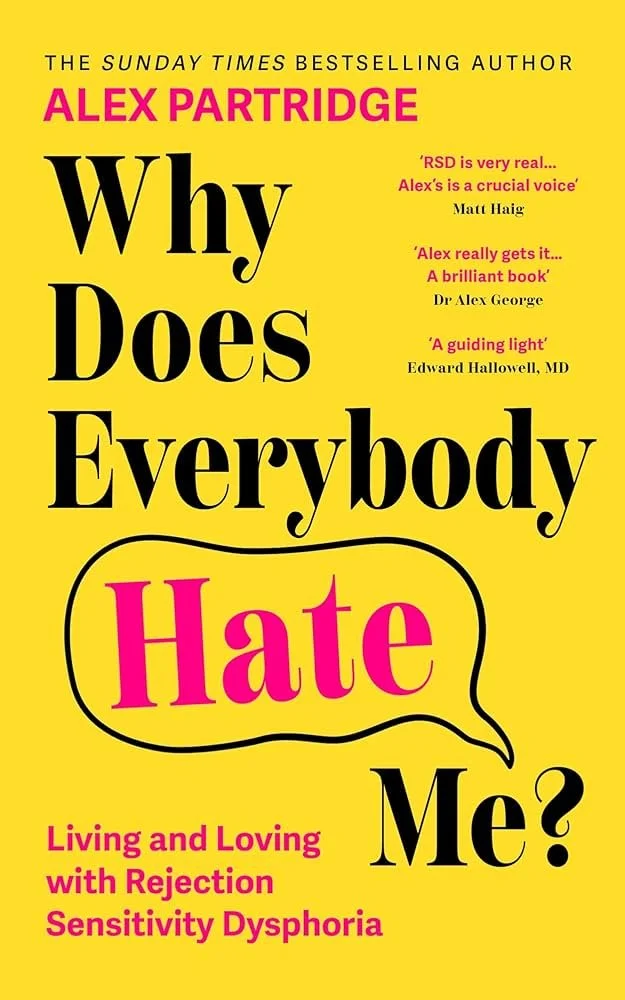
Why Does Everybody Hate Me? is a compassionate, validating, and deeply human exploration of Rejection Sensitive Dysphoria (RSD) by ADHD advocate Alex Partridge. Through personal stories, humor, and accessible psychoeducation, Partridge gives language to an experience many neurodivergent people live with silently—often wrapped in shame, confusion, and self‑doubt.
As a therapist, I was struck by how precisely this book reflects what I see clinically.
As someone living with RSD myself, it brought up a mix of anger, grief, relief, and recognition—sometimes all on the same page.
Alex Partridge doesn’t bury the lead. He tells you exactly what this book is about:
“Its all about Rejection Sensitive Dysphoria (RSD), something I truly believe to be the hardest part of ADHD.”
There were moments I had to put the book down. Not because it was dramatic or overwhelming, but because it was accurate. The book didn’t exaggerate RSD. It named it.
Partridge also answers his own question with disarming directness:
“Why did I write this book?
RSD hurts like hell.”
That sentence alone explains why this book matters. It doesn’t try to talk readers out of their experience. It names it clearly — and then offers language and pathways forward.
What Is Rejection Sensitive Dysphoria (RSD)?
Rejection Sensitive Dysphoria (RSD) refers to intense emotional pain triggered by perceived or actual rejection, criticism, or failure. While it is not a formal DSM diagnosis, it is widely recognized by ADHD specialists as a form of emotional dysregulation, most commonly associated with ADHD and other neurodivergent profiles.
The word dysphoria means “difficult to bear.” And for people with RSD, that description is painfully exact. The response is often immediate, overwhelming, and deeply embodied. What might feel mildly uncomfortable to one person can register as emotionally devastating to someone with RSD.
Partridge dismantles the myth that RSD is simply “being too sensitive.” Instead, he frames it as a nervous system that reacts to perceived disconnection as though safety itself is at stake.
Partridge frames the “why” behind it like this:
“People with ADHD experience something called Rejection Sensitive Dysphoria, it causes intense pain and is triggered by real or perceived rejection, and it happens because ADHD people were criticized 20,000 more times than your average child.”
He also emphasizes the core experience: the pain isn’t a mild sting. It’s heavy, fast, and often overwhelming — a theme echoed in multiple clinical and psychoeducational descriptions of RSD.
Actual Rejection vs. the Felt Experience of RSD
One of the most validating distinctions Partridge makes is between actual rejection and the felt experience of rejection when RSD is activated.
Actual rejection is real. People do leave, say no, pull away, or disappoint us. When that happens, pain is normal and appropriate.
RSD, however, does not require actual rejection to activate. It is often triggered by:
ambiguity
anticipation
silence
a shift in tone
a delayed response
And this is critical to name:
The pain of RSD is real—even when rejection itself is not.
RSD is a nervous‑system event, not a cognitive misunderstanding. The body reacts first—before the thinking brain has time to assess what’s actually happening.
This is why someone with RSD can logically know:
“They probably aren’t mad at me,”
“This doesn’t mean I did anything wrong,”
“Nothing bad has actually happened,”
…and still feel completely undone.
Both things can be true:
It may not be actual rejection
And the pain still deserves care
Invalidating that pain because rejection hasn’t “technically” happened only deepens shame and prolongs spirals.
The Physical Reality of RSD: When Emotional Pain Lives in the Body
One of the most misunderstood aspects of RSD—and one Partridge names clearly—is that RSD pain is not just emotional. It is physical.
People with RSD are often told:
“Don’t take it so personally.”
“Try not to read into it.”
“Just calm down.”
These responses assume the distress lives primarily in thoughts. For many of us, RSD begins in the body.
The nervous system reacts before there is time to think.
Common physical experiences during an RSD episode include:
A sudden hollow or dropping sensation in the stomach, like a free‑fall
Tightness or pain in the chest, sometimes described as heartbreak or pressure
A lump in the throat or difficulty swallowing
Feeling winded, shaky, flushed, or nauseous
A sense of collapse, dissociation, or urgent need to escape
Many people describe RSD as feeling like they’ve been punched in the chest or emotionally “winded”—even when nothing overt has happened.
Partridge highlights a key neuroscience reality:
the brain processes social rejection using some of the same neural pathways as physical pain.
This is why the pain feels real—because it is real.
Personally, some of my most intense RSD reactions have started not with catastrophic thoughts, but with a body signal:
a sudden heaviness in my chest after reading a short text
a rush of nausea after sensing a subtle shift in tone
the urge to withdraw or disappear before I could articulate why
Only afterward did the story show up: I messed up. I’m too much. I don’t belong.
Understanding RSD as a somatic experience changes how we respond. Regulation has to start with safety, grounding, and reassurance—not logic alone.
What RSD Feels Like — Especially Inside Relationships
RSD tends to show up most strongly in relationships that matter.
Caring increases emotional risk. With that risk comes hyper‑vigilance: scanning for tone changes, pauses, facial expressions, or moments of ambiguity that the brain can quickly interpret as rejection.
Reading this section brought up anger and grief for me—anger at the sheer amount of internal work required just to stay regulated, and grief for how RSD has shaped my relationships.
Many people with RSD live in a painful tension:
Needing reassurance, clarity, and patience
While desperately not wanting to feel needy or burdensome
Partridge names a thought many are afraid to say out loud:
Why would anyone want to partner with me—or be close friends with me—if this is what my inner world is like?
That question doesn’t come from self‑hatred.
It comes from chronic emotional labor.
The Hidden Exhaustion of Managing Yourself Around Others
Partridge speaks to something rarely acknowledged:
the exhaustion of managing yourself in close relationships when you live with RSD.
Monitoring reactions.
Rewriting internal narratives.
Pausing before responding.
Talking yourself down from emotional cliffs.
Apologizing for feelings you didn’t choose.
Over time, this constant self‑regulation can become so draining that distance starts to feel safer than connection.
Not because you don’t want closeness—but because closeness requires so much work.
Sometimes withdrawal isn’t avoidance. It’s fatigue.
RSD and Perfectionism: “If I Do Everything Right, I Can’t Be Rejected”
Another powerful insight in the book is its reframing of perfectionism.
Perfectionism isn’t about excellence.
It’s about safety.
Partridge explains how perfectionism becomes a survival strategy: if I anticipate needs, say the right thing, perform well, and never misstep, maybe I can prevent rejection before it happens.
For many with RSD, perfectionism looks like:
Over‑preparing for interactions
Replaying conversations afterward
Holding impossibly high standards
Deep shame over small mistakes
Believing connection must be earned
Perfectionism becomes an attempt to control connection—and over time, it leads to exhaustion, isolation, and self‑erasure.
When RSD Leads Us to Lower Our Standards and Settle for Less
Another painful pattern Partridge gently names is how RSD can lead us to lower our standards in relationships and tolerate being treated poorly.
When rejection feels unbearable, the nervous system often prioritizes any connection over healthy connection.
The internal logic may sound like:
Maybe I’m asking for too much.
At least they’re still here.
If I speak up, they might leave.
I should be grateful anyone wants me.
RSD can quietly distort our sense of what we’re allowed to want. When fear of rejection is intense, self‑abandonment can feel safer than risking disconnection.
This isn’t a character flaw. It’s survival.
But over time, lowering standards creates a quieter, deeper harm. Resentment builds. Exhaustion grows. And the belief that “this is all I can expect” becomes harder to challenge.
Raising standards with RSD isn’t arrogance—it’s courage.
Getting Out of an RSD Shame Spiral: What Actually Helps
Shame spirals are often the most painful part of RSD—when perceived rejection turns into “I am too much,” “I am unlovable,” or “I don’t belong.”
Partridge reminds us that logic rarely works in the moment. RSD is a nervous‑system response, not a reasoning one.
When RSD hits, it often triggers a fast, brutal shame spiral:
I’m too much.
They’re annoyed with me.
I ruined it.
No one actually wants me.
In those moments, logic is usually the wrong starting point. RSD is a nervous‑system experience first, not a thinking one. What helps most is regulation—not convincing yourself anything.
Here are the tools that have helped me most in real life.
Anchor, Don’t Argue
When I’m spiraling, I do not start by debating the thoughts in my head. I don’t ask, Is this rational? or What evidence do I have?
Instead, I anchor.
I keep a dedicated photo album on my iPhone specifically for moments when RSD and shame hit. I have had it for years and find it incredible helpful. It includes:
Photos of handwritten notes friends have given me
Birthday and holiday cards
Screenshots of meaningful texts or emails
Photos tied to grounding memories of connection (shared dinners, trips, ordinary moments that felt safe)
This album is not about “proof” in a legal sense. It’s not about winning an argument with my brain.
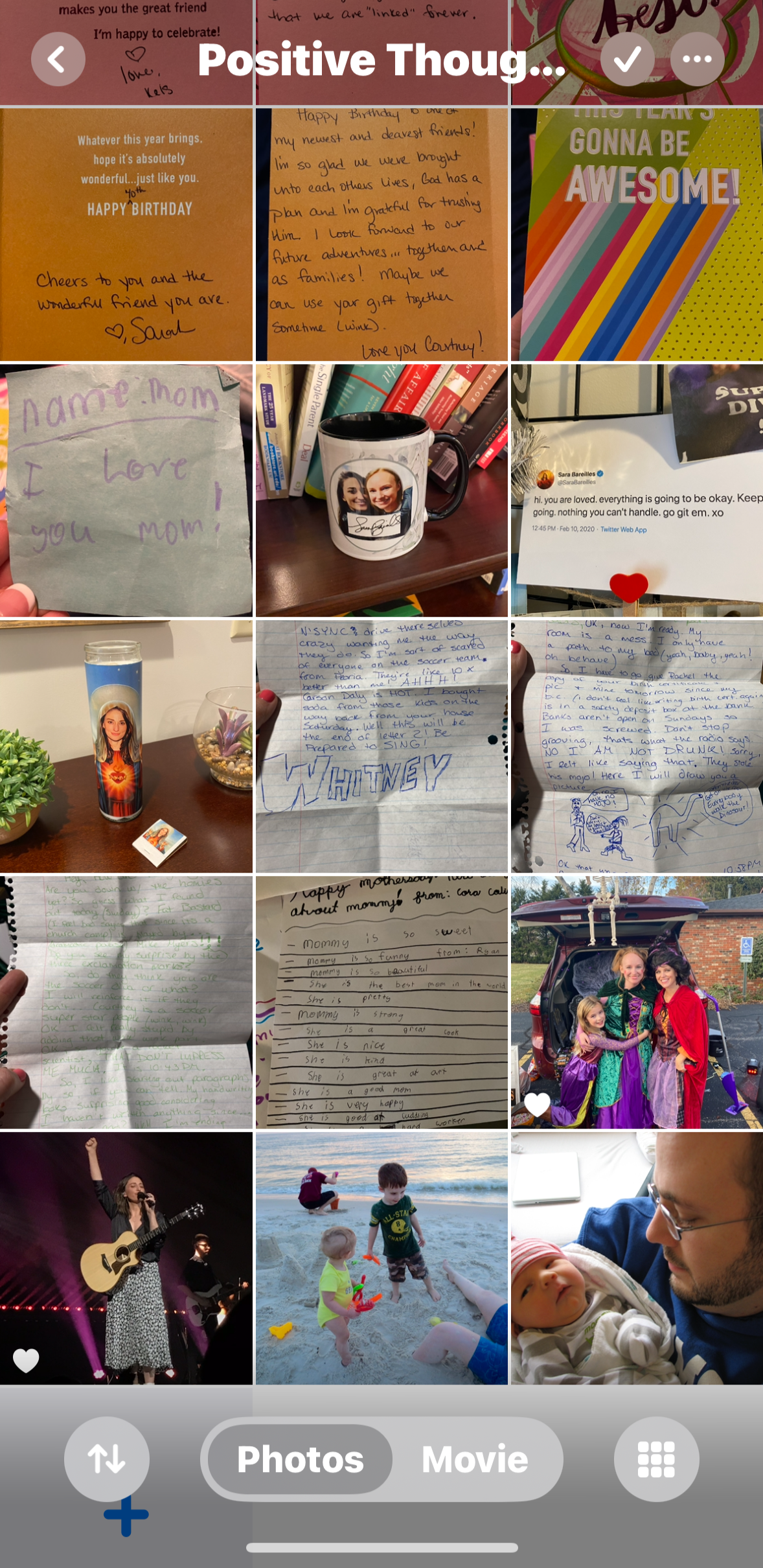
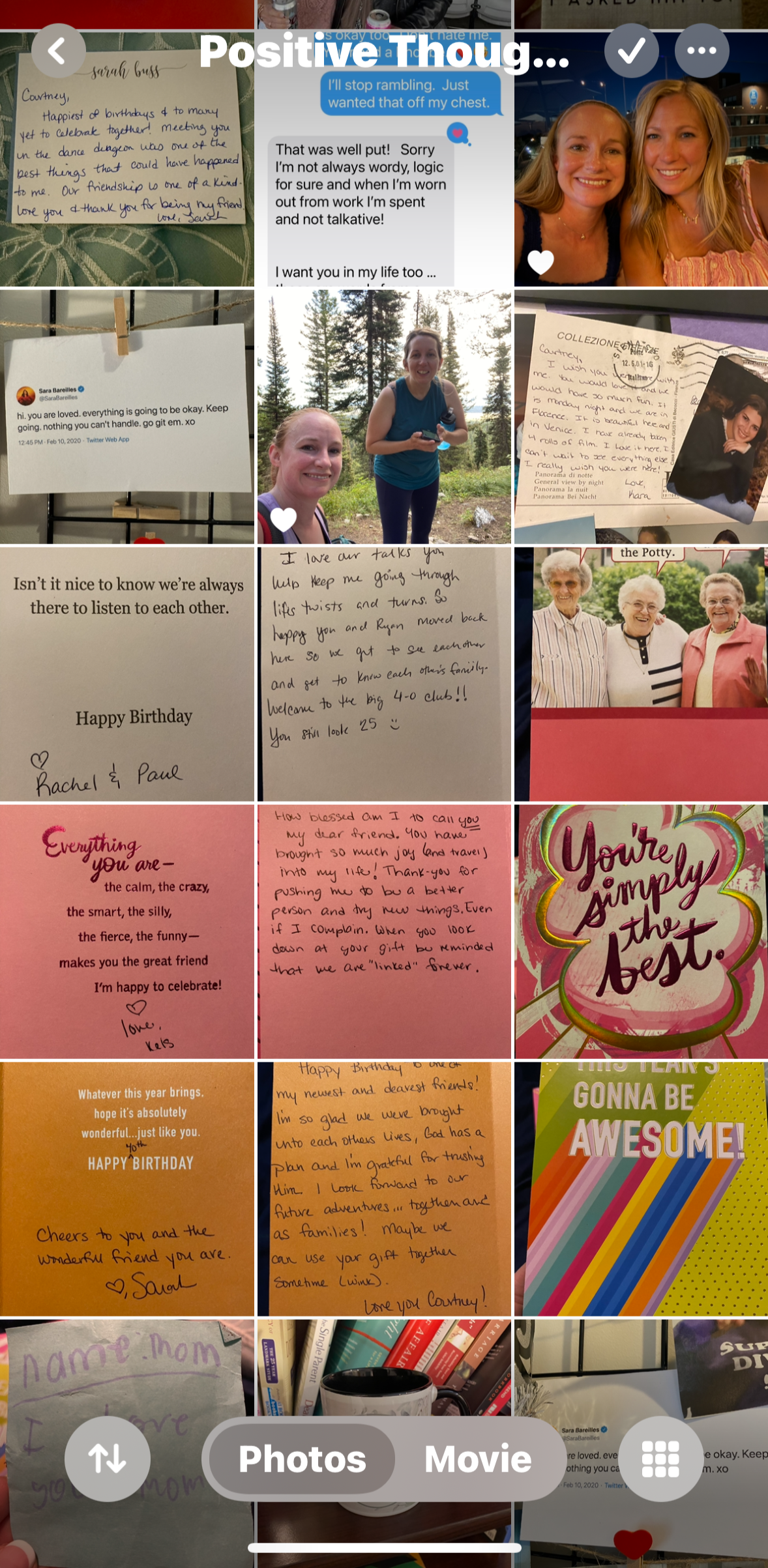
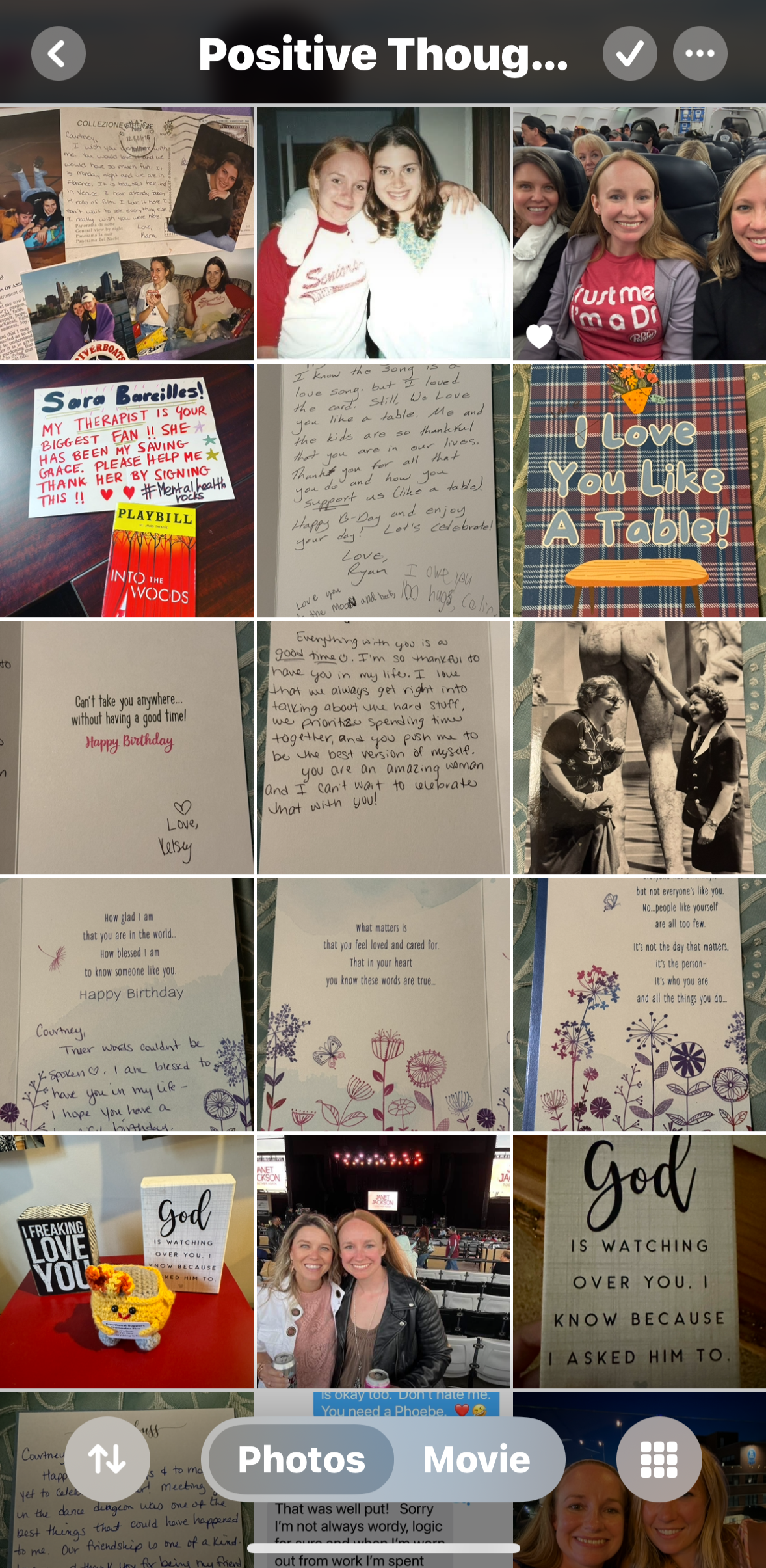
It’s about felt safety.
When shame says, “No one wants you. You’re tolerated at best,” I scroll. Slowly. Intentionally. I don’t rush it. I let my nervous system see faces, handwriting, words that came from people who chose connection with me.
What I notice is this: my breathing changes. My shoulders drop. The intensity softens enough that I can think again.
This works because RSD isn’t just a story—it’s a body state. Anchoring gives the nervous system sensory evidence of belonging, which calms the threat response faster than logic ever could.
Name What’s Happening
One of the most powerful (and simplest) steps is quietly naming what’s happening:
“This is RSD.”
Not:
I’m ridiculous.
I’m overreacting.
What is wrong with me?
But:
My nervous system is activated.
This is RSD doing what it does.
Naming it creates distance between who you are and what’s happening in your body.
It also interrupts shame. Instead of the spiral becoming “I am the problem,” it becomes “Something is happening to me—and I know what it is.”
I’ll often say this silently to myself before doing anything else:
This is RSD. I don’t need to solve the relationship right now. I need to regulate.
That alone can reduce the urgency enough to prevent impulsive texts, apologies, or emotional withdrawal that I later regret.
Delay Meaning‑Making
RSD demands immediate meaning: That tone meant they’re mad.
That pause means I messed up.
That vague message means I’m unwanted.
One of the hardest but most effective skills is delaying that meaning.
Delay doesn’t mean denial. It means not deciding the story while activated.
This can look like:
Waiting an hour before responding to a triggering text
Sleeping on it before sending the long explanation or apology
Saying to yourself, “I don’t have enough information yet.”
Even brief delays help because emotional intensity naturally peaks and falls. Once the body settles even slightly, the story often changes—or at least softens.
I’ll sometimes literally tell myself:
This feels urgent, but it isn’t. I can decide tomorrow.
Delay is a way of protecting both your relationships and your dignity from the heat of the RSD moment.
Seek Reassurance Without Shame
This one matters deeply.
Many people with RSD avoid reassurance because they’re afraid of being:
too needy
too much
a burden
But here’s the truth: reassurance is not weakness—it’s co‑regulation.
RSD developed in a nervous system that experienced repeated criticism, inconsistency, or relational unpredictability. Reassurance helps repair that learning.
Healthy reassurance sounds like:
“Hey, my brain is spiraling—can you tell me if we’re okay?”
“I might be reading into this. Were you upset, or just busy?”
“Can you reassure me that we’re good? That would help me settle.”
This is not asking someone else to manage your emotions forever. It’s using relationship as a healing resource, not a threat.
Over time, consistent reassurance doesn’t increase dependency—it often reduces reactivity, because the nervous system learns that clarity and care are available.
The goal isn’t to never need reassurance.
The goal is to receive enough safety that your system doesn’t have to scream for it.
A Gentle Reframe
None of these tools are about becoming less sensitive.
They’re about:
working with your nervous system instead of against it
responding to pain with compassion instead of shame
staying connected without disappearing
RSD doesn’t mean you’re broken.
It means your body learned how much rejection hurts—and did everything it could to protect you from that pain.
These tools aren’t fixes.
They’re supports. And for many of us, support is exactly what allows healing to happen.
The Overlap Between RSD, ADHD, and Childhood Trauma
RSD is closely linked to ADHD—but it often overlaps with childhood and relational trauma.
For those who grew up with emotional inconsistency, chronic criticism, bullying, or conditional love, rejection is rarely just about the present moment.
Trauma teaches the nervous system:
Love can be withdrawn
Belonging must be earned
Disconnection is dangerous
When trauma and neurodivergence overlap, the nervous system becomes hyper‑vigilant. Small ambiguities may activate old fears:
If I am rejected, I am not safe.
These patterns reflect adaptation, not defect.
For Partners, Friends, and Family: Communicating with Care
And Why an Explicit Invitation Matters
A core message of this book is how much communication style—and explicit invitation—matter.
Neutral language is often not neutral to an RSD nervous system. Silence, short replies, vague tone, or delays can feel like withdrawal.
And critically:
People with RSD often need an explicit invitation to communicate.
Many of us don’t ask for reassurance because we’re trying not to be “too much.”
Helpful practices include:
Saying the invitation out loud (“If you’re unsure, you can ask me”)
Being explicit rather than neutral
Pairing pauses with reassurance
Using warmth intentionally
Reassurance doesn’t make RSD worse. It helps regulate it.
Partridge explains how repeated criticism accumulates into a nervous system that expects rejection — and he gives examples of the kinds of messages ADHD kids often hear:
“Why are you being weird, it’s not that loud in here”
“You’re embarrassing yourself”
“Why are you being lazy?”
“Stop biting your nails!”
“Why are you crying?!”
“You’ve let me down!”
“You’re really rude”
“Stop being weird!”
“Stop fidgeting”
“Calm down”
“Be normal!”
“Stop it!”
And he connects that history to how adults interpret social information:
“And it means that as as adult, they read positive comments as neutral, in fact they don’t believe positivity, it bounces off them, they read neutral comments like ‘come to the party if you like’, as negative and when they experience actual negative comments, well, let’s just say you don’t want to be around for that. Instant rage, sadness and crippling shame. It’s brutal.”
That “instant” emotional shift and the intensity of shame/anger/sadness maps closely onto common clinical descriptions of RSD as a rapid, painful reactivity pattern.
Final Reflections
This book didn’t make RSD easy—but it made it less lonely.
It helped me hold two truths at once:
RSD can be profoundly exhausting
People with RSD are not broken, unlovable, or too much
Needing clarity, patience, and care doesn’t make you weak.
It means your nervous system learned how to survive.
If you live with Rejection Sensitive Dysphoria, I want you to hear this clearly: nothing about you is “too much,” broken, or shameful. Your nervous system learned early that connection could be fragile and that rejection could hurt deeply—and it adapted in the only ways it knew how. That sensitivity you carry is not a flaw; it is evidence of how deeply you care, how attuned you are, and how hard you have worked to belong. Healing RSD isn’t about becoming less yourself or feeling less—it’s about learning that you are allowed safety, clarity, connection, and reassurance without earning them through perfection or self-erasure. You are not imagining your pain. You are not weak for needing support. And you do not have to disappear in order to be loved. You are worthy of care exactly as you are, in this moment, and you always have been.
References & Further Reading
Partridge, A. (2026). Why Does Everybody Hate Me? Living and Loving with Rejection Sensitive Dysphoria. Sheldon Press. (Publication details and description) [allbelong.com], [neurodiver...odcast.com]
Cleveland Clinic. (2022). Rejection Sensitive Dysphoria (RSD): overview and symptoms. [youtube.com]
Mutti‑Driscoll, C. J. (2026). “Rejection Sensitive Dysphoria: The Iceberg Under the Surface.” Psychology Today.
Rowney‑Smith, A., Sutton, B., Quadt, L., & Eccles, J. A. (2026). The lived experience of rejection sensitivity in ADHD (qualitative themes include withdrawal and bodily sensations). PLOS One. [bookhero.co.nz]
Rehman, M., & Quddos, S. (2025). Childhood trauma and rejection sensitivity associations. Journal of Child & Adolescent Trauma. [coles-books.co.uk]
Clark, G. (2026). RSD and trauma overlap (relational trauma and nervous system threat responses). A Braver Space. [youtube.com]
Magdi, H. M., et al. (2025). ADHD and PTSD adult comorbidity (systematic review). Systematic Reviews. [youtube.com]
Chester, D. S., DeWall, C. N., & Pond, R. S. (2016). Evidence for overlap between social pain and physical-pain-related neural signatures. Cognitive, Affective, & Behavioral Neuroscience. [takecontroladhd.com]
Woo, C‑W., et al. (2014). Pain and social rejection neural representations (overview of the research context). Nature Communications. [discoveryo...athllc.com]