

The Self‑Care Strategy: Building a Life You Don’t Need to Escape From
Self‑care.
If you’re anything like me, you probably sighed—or rolled your eyes—a little when you read that word.
Over the past few years, self‑care has taken on a life of its own. Social media is flooded with perfectly curated images and ads promoting the latest self‑care trend. Most of them require extra time, extra money, or both—and let’s be honest, who has an abundance of either these days?
Self‑care.
If you’re anything like me, you probably sighed—or rolled your eyes—a little when you read that word.
Over the past few years, self‑care has taken on a life of its own. Social media is flooded with perfectly curated images and ads promoting the latest self‑care trend. Most of them require extra time, extra money, or both—and let’s be honest, who has an abundance of either these days?
Despite its trendy reputation, self‑care is essential to our overall well‑being. The problem is that many of us have been sold a version of self‑care that misses the point entirely. It’s not just pedicures, impulse Amazon purchases, or Netflix binges (though those things absolutely have their place). When self‑care gets reduced to occasional treats instead of intentional care, many people end up stuck in a familiar cycle: pushing through exhaustion, burning out, and wondering why they still feel depleted.
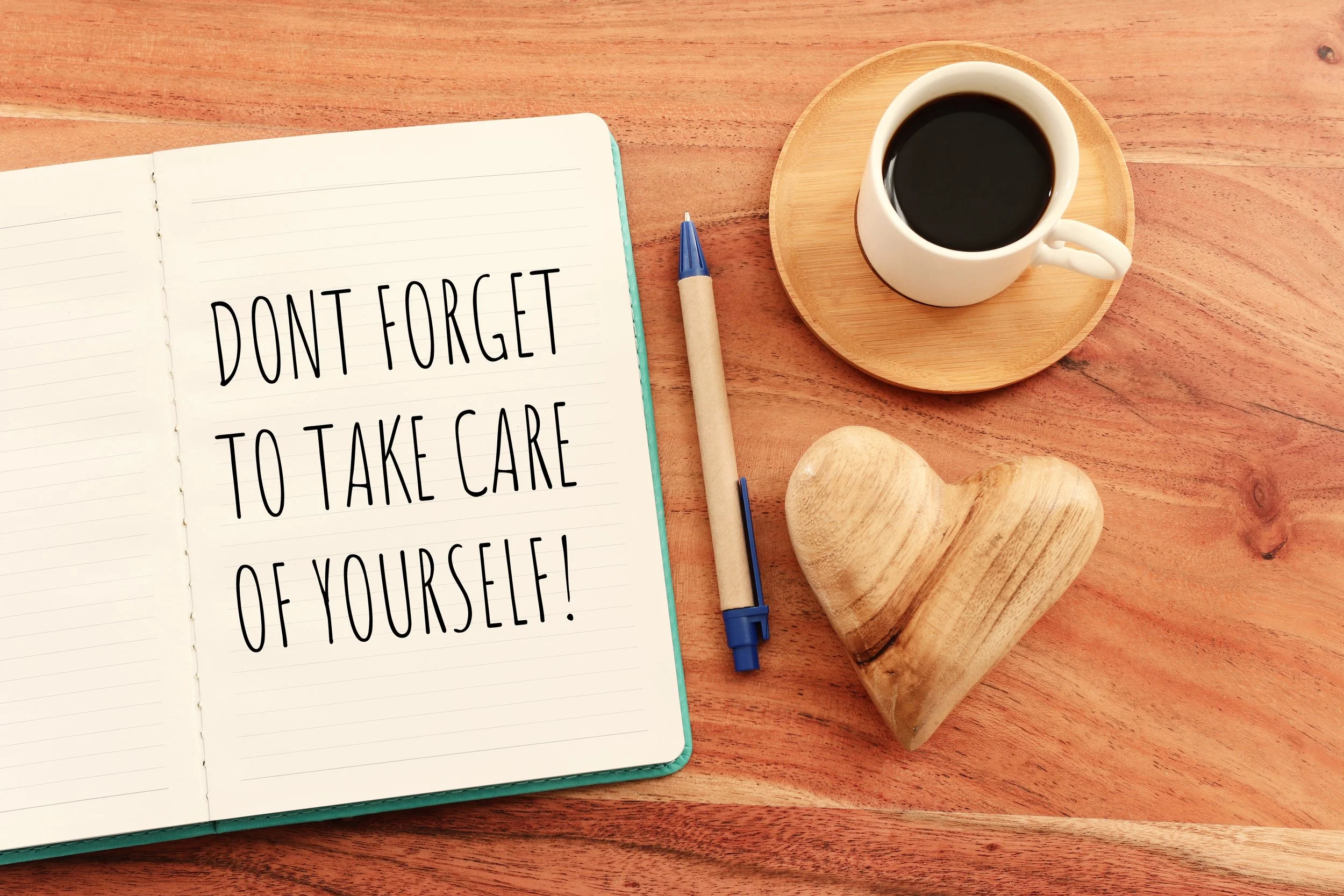
Self‑Care: The What (and the What Not)
So what is self‑care, really?
At its core, self‑care simply means caring for yourself. It’s about meeting your needs consistently, not perfectly. Self‑care can be broken down into a few basic areas: physical, mental, emotional, social, and spiritual. While we all share these categories, what fills them will look different for each person.
I love a good metaphor, so let’s look at self‑care through the lens of caring for a puppy.
The puppy needs walks and grooming to stay healthy (physical).
The puppy needs training and challenges to stimulate her mind and build self‑control (mental).
The puppy needs affection and reassurance that she’s the goodest girl (emotional).
The puppy needs socialization to learn how to interact with others (social).
Now, what happens if one or two of those needs get ignored?
Without enough physical activity, the puppy has too much energy and gets into trouble.
Without mental stimulation, she gets bored and chews things she shouldn’t.
Without affection, she becomes sad and insecure.
Without socialization, she struggles with boundaries and relationships.
Sound familiar?
Now Let’s Apply This to You
One of the most common things I hear from people is, “I don’t even know where to start.” That makes sense—our lives are already packed with responsibilities, obligations, and endless to‑do lists.
A helpful place to begin is by creating a Self‑Care Menu. This takes a little upfront effort, but it sets you up for long‑term success.
Start by making a list of activities that fit into each self‑care category (physical, mental, emotional, social, spiritual). Choose things you genuinely enjoy and find life‑giving—not things you feel like you should do.
Next, get realistic about time.
A walk might take anywhere from 5 to 30+ minutes.
Many grounding exercises can be done in under 10 minutes.
Reading, journaling, or working on a puzzle can be flexible.
Coffee with a friend might take 30–60 minutes.
Once you have your menu, begin weaving these options into your day when small pockets of time appear. Over time, you’ll start to notice which areas need attention and which feel more balanced.
If a puppy has boundless energy, you know she needs a walk. If she won’t stop jumping on the counter, she probably needs some training and structure. The same is true for us. Our stress, irritability, exhaustion, or emotional shutdown are signals—not failures.
The puppy deserves consistent care.
And so do you.
Book Review: Burnout by Emily & Amelia Nagoski
Emily and Amelia Nagoski’s Burnout: The Secret to Unlocking the Stress Cycle is one of the most clinically useful, validating, and culturally honest books I’ve encountered on chronic stress and emotional exhaustion. As a therapist who works daily with clients who feel depleted, overwhelmed, and quietly ashamed for “not handling life better,” I consider this book essential reading—for clients and clinicians alike.
Emily and Amelia Nagoski’s Burnout: The Secret to Unlocking the Stress Cycle is one of the most clinically useful, validating, and culturally honest books I’ve encountered on chronic stress and emotional exhaustion. As a therapist who works daily with clients who feel depleted, overwhelmed, and quietly ashamed for “not handling life better,” I consider this book essential reading—for clients and clinicians alike.
One of the book’s most important contributions is its clear distinction between stressors and stress. Stressors are the external pressures we face—work demands, caregiving, financial strain, societal expectations. Stress, however, is the physiological response that lives in the body, often long after the stressor has passed. Burnout, the Nagoskis argue, is what happens when we repeatedly encounter stressors without completing the biological stress cycle—when the body never fully receives the signal that it is safe to rest and recover.

From a clinical standpoint, this reframing is powerful. Many people believe they should feel better once they “solve the problem,” yet their nervous systems remain stuck in fight‑or‑flight. The book makes clear that dealing with stress is a separate process from solving problems, and that healing requires intentional completion of the stress response through movement, rest, laughter, crying, affection, creativity, and connection—not just insight or productivity.
What truly sets Burnout apart, however, is how directly it addresses culture, not just individual coping. The Nagoskis explicitly name the systems that keep stress cycles perpetually open—particularly for women. Two concepts are especially impactful: Human Giver Syndrome and the Bikini Industrial Complex.
The Bikini Industrial Complex refers to the multibillion‑dollar system that profits from convincing women that their bodies are perpetual problems to be fixed—too big, too small, too old, too much. Through marketing, media, and “wellness” messaging, women are taught to monitor, judge, and discipline their bodies constantly. This ongoing self‑surveillance keeps the nervous system in a chronic state of threat, reinforcing shame, hypervigilance, and exhaustion.
Clinically, I see the effects of this every day. Body dissatisfaction is not a superficial concern—it is a chronic stressor. When someone is at war with their body, true rest becomes nearly impossible. The Nagoskis’ work helps readers understand that struggling to “love your body” in a culture designed to profit from self‑loathing is not a personal failure; it is a predictable response to systemic pressure. Naming the Bikini Industrial Complex gives language to a stressor that many people have internalized but never been taught to question.
Importantly, Burnout does not offer performative positivity or shallow self‑care as solutions. The authors are clear: spa days and bubble baths cannot fix systemic stress. Instead, they emphasize practices that biologically signal safety to the body and challenge the cultural narratives that equate worth with productivity, appearance, or self‑sacrifice. This aligns closely with trauma‑informed and evidence‑based therapeutic approaches that prioritize nervous system regulation and self‑compassion.
The tone of the book is another strength. The Nagoskis write with warmth, humor, and deep empathy. Rather than prescribing rigid rules, they repeatedly return to a core message I often echo in therapy: you are not broken. Burnout is not evidence that you are weak or failing—it is a reasonable response to prolonged stress in an unreasonable environment.
Readers should know that Burnout is written primarily with women in mind and explicitly addresses sexism, emotional labor, and inequity. For some, this will feel deeply affirming; for others, it may feel uncomfortable. From a clinical perspective, that discomfort is meaningful. Burnout does not exist in a vacuum, and ignoring the systems that fuel it only perpetuates shame.
Who I recommend this book for:
Clients experiencing chronic stress, emotional exhaustion, or body‑based shame
Clinicians, caregivers, and helpers at risk for compassion fatigue
Anyone who has tried “doing more” to feel better—and ended up more depleted
Burnout is not about fixing yourself. It is about understanding how your body responds to stress, recognizing the cultural forces that keep you stuck, and learning how to move toward rest, connection, and self‑trust in a sustainable way.

Yoga and Mental Health: How Mindful Movement Supports Emotional Well-Being
In today’s fast-paced world, it’s easy for stress, anxiety, and emotional overwhelm to take hold. Many people are seeking ways to support their mental health beyond talk therapy, medication, or traditional self-care. One powerful approach that has gained recognition in both clinical and wellness communities is yoga.
In today’s fast-paced world, it’s easy for stress, anxiety, and emotional overwhelm to take hold. Many people are seeking ways to support their mental health beyond talk therapy, medication, or traditional self-care. One powerful approach that has gained recognition in both clinical and wellness communities is yoga.
Yoga is more than stretching or physical exercise—it is a practice that integrates the mind, body, and breath, helping individuals cultivate awareness, balance, and resilience. Research has shown that yoga can positively impact mental health by reducing stress, improving mood, and supporting emotional regulation.
How Yoga Supports Mental Health
1. Reduces Stress and Anxiety
Yoga encourages mindful breathing and relaxation, activating the parasympathetic nervous system—the body’s natural “rest and digest” response. This helps lower cortisol levels, calm the mind, and reduce the physical symptoms of stress and anxiety.
2. Improves Emotional Regulation
Through consistent practice, yoga helps individuals notice and respond to their emotions with awareness rather than react impulsively. This can be particularly beneficial for managing anger, frustration, or anxiety.
3. Enhances Mind-Body Connection
Trauma and chronic stress can disconnect us from our bodies, leaving us feeling tense, numb, or unsafe. Yoga emphasizes grounding, body awareness, and gentle movement, helping reconnect the mind and body in a safe, supportive way.
4. Boosts Mood and Resilience
Physical movement, breathwork, and mindfulness practices in yoga stimulate the release of endorphins and serotonin, improving overall mood. Regular practice also builds resilience, helping people cope with challenges more effectively.
5. Supports Trauma Healing
Certain forms of yoga, especially trauma-informed yoga, provide a safe environment for people to explore sensations, release tension, and regain a sense of control in their bodies. When combined with therapy, yoga can complement emotional healing in profound ways.
6. All Bodies Are Welcome
Yoga is for everyone—regardless of age, size, ability, or experience. Our approach emphasizes adaptation and accessibility, ensuring that each person can participate safely and comfortably. The practice is about connecting with your body, not achieving a specific pose or appearance. All bodies deserve to move, breathe, and experience the healing benefits of yoga.
Tips for Incorporating Yoga into Mental Health Care
Start small: Even 10–15 minutes a day can make a difference.
Focus on breath: Mindful breathing is often more impactful than the poses themselves.
Seek trauma-informed classes: Look for instructors trained to support people with trauma histories.
Combine with therapy: Yoga can complement counseling by enhancing self-awareness, stress reduction, and emotional regulation.
Be gentle and patient: Yoga is a journey, not a performance. Progress is measured in awareness, not flexibility.
Final Thoughts
Yoga is not a cure-all, but it is a powerful tool to support mental health. By integrating movement, mindfulness, and breath, individuals can cultivate a stronger mind-body connection, reduce stress, and foster resilience.
At Summit Family Therapy, I encourage clients to explore approaches like yoga alongside therapy to support holistic well-being. If you are ready to combine mind-body practices with evidence-based therapy for mental health, I invite you to schedule a session with me, Dr. Courtney Stivers, and begin your journey toward balance, healing, and emotional wellness.
For women seeking a supportive, healing environment, consider joining an upcoming Women’s Trauma Recovery Workshop. It’s a safe space to connect, process trauma, and explore tools—like yoga and mindfulness—that can empower your mental and emotional well-being.